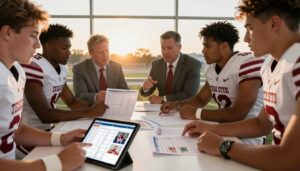
I’m opening the hood on how a sleepy FBS program stopped being background noise. After a long stretch of being overlooked, G.J. Kinne arrived and changed expectations fast. He came from Incarnate Word with a 12-2 season and an FCS semifinal run, then delivered eight-win campaigns and back-to-back bowl victories.
What do I mean by “recruiting philosophy”? It’s not just names on a list. It’s how the head coach and his team talk, evaluate, and sell a vision that finally sounded coherent.
There’s tension here: portal pragmatism versus rebuilding high school ties. Kinne framed a “Take back Texas” mission that was more than merch. It signaled a rise in standards and a clearer program identity.
Think of modern college football as a startup with shoulder pads. I’ll map the ecosystem—coaches, support roles, and the emerging front office vibe—so you can see how the shift actually worked.
Texas State’s Rise Under G.J. Kinne Sets a New Bar for Recruiting
What used to feel like background noise turned into a broadcast worth tuning into.
The program joined FBS in 2012 and then drifted through coaching changes and missed opportunities.
After Spavital left in 2022, g.j. kinne arrived with high-major and NFL proximity. In two seasons he went 19-11, posted back-to-back eight-win seasons, and delivered the program’s first two bowl wins with consecutive First Responder Bowl victories.
That scoreboard proof matters. Wins turned an optimistic sales pitch into tangible momentum for the head coach and the team. Bowl photos are not just selfies; they are recruiting currency.
- Seven-win peaks under earlier regimes felt like flashes; Kinne made consistency an expectation.
- The planned move to the Pac-12 widens the program’s reach and perception across families and high schools.
| Metric | Pre-2012–2022 | 2023–2024 (Kinne) |
|---|---|---|
| Best season | 7-5 (2014) | 8-? (each season) |
| Overall record (select years) | Variable, coaching turnover | 19-11 |
| Bowl wins | 0 | 2 (First Responder Bowl) |
For deeper context on player pathways and evaluation, see dual-sport pathways. Expectations have shifted; now the real work is keeping that narrative from slipping back into a feel-good footnote.
New Faces, New Infrastructure: How the Staff Is Built to Recruit Year-Round
This was less about a splash hire and more about assembling a machine that runs year-round. The hires signal a shift: systematic evaluation, development, and pipeline control instead of sporadic outreach.
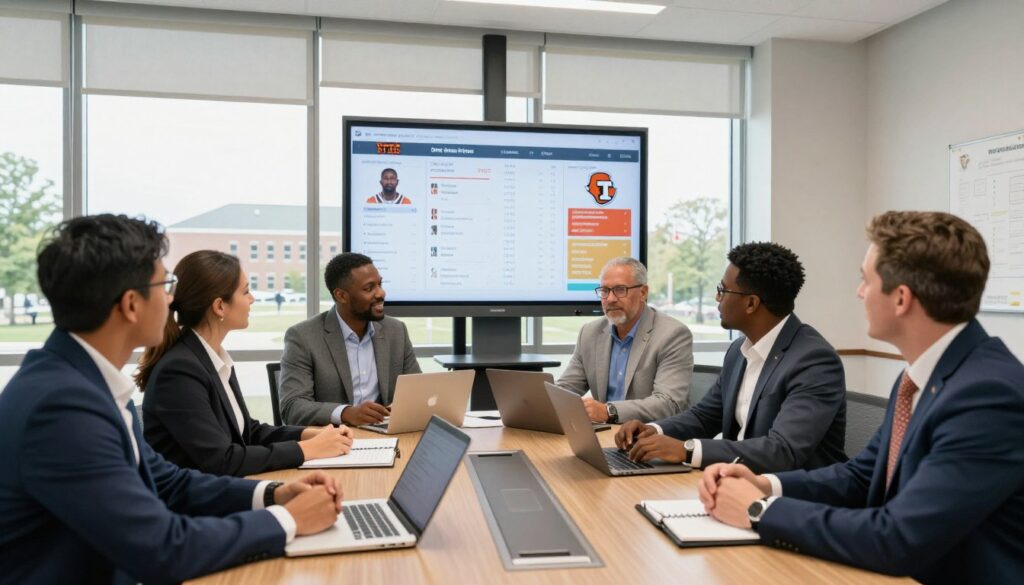
Offense: Joe Jon Finley brings NFL experience and five years at Oklahoma as co-offensive coordinator and tight ends coach. That résumé is shorthand for “we know big-time work.”
John Roberts arrives as game management coordinator, formalizing the chess moves that used to live on a single notepad.
Defensive reshuffle and depth
Will Windham takes the defensive coordinator role while Marcus Patton and Chris Gistorb rebuild the secondary and line. Add Kyle Skierski to the rotation; depth matters because the unglamorous work wins seasons.
Front office: talent acquisition as a function
Justin “Coach O” Owens steps in as general manager. With 15+ years in Texas high school evaluation and a recent Director of Recruiting title at North Texas, he brings a local pipeline and relationship equity.
- Year-round system: These hires turn scouting into an operational flow, not a calendar sprint.
- Coordinator-level credibility: Finley and Roberts sell development to recruits and parents.
- Pipeline access: Owens’ high school network shortens the path from prospect to roster.
Put it bluntly: recruiting is the input, development is the process, and Saturday is the scoreboard. This build aims to make those connections repeatable.
Inside texas state coaching staff recruiting: Philosophy, Priorities, and the “Take Back Texas” Push
The program stopped treating high school coaches like convenience stops and started courting them like partners. That change matters more than a glossy slogan.
Philosophy: For years the portal was the main course. Now the menu includes in-state relationships, weekend visits, and deliberate trust-building.
Roles that move the needle
Who evaluates: scouts and the front office map prospects over years, not just seasons.
Who builds ties: position coaches and the general manager handle the emotional work—calls, film nights, and showing up.
Who develops: developers and game-day coaches turn signings into wins on Saturday.
The Louisiana moment and the schedule as leverage
After that loss, g.j. kinne warned everything would be “on the table.” Translation: standards, roles, and accountability got real.
The 2026 opener at Texas is more than a game. It’s a visible promise to recruits. Three home nonconference weekends—UTSA, North Texas, Incarnate Word—become built-in showcases.
- Strategy over slogans: The “Take back Texas” push demands time, credibility, and presence.
- Timeline: Repair relationships across years, then convert visits into commitments.
Conclusion
Everything that changed on the sideline eventually landed in the locker room—and on the scoreboard.
Wins did the selling. Two eight-win seasons, a 19-11 run, and back-to-back First Responder Bowl victories created real momentum.
The coach sold a vision; the head backed it with structure. Add experienced hires—Finley, Roberts, Windham, Patton, Gistorb—and Justin “Coach O” Owens to a staff build meant for nonstop evaluation and relationship work. ,
Visibility will grow with a Pac-12 move and a 2026 opener at Texas. But visibility is not the same as credibility. Can this program turn momentum into steady development and results? That’s the question now.