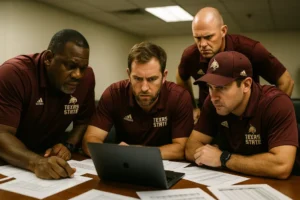
Rashawn Galloway became one of the defining players of Texas State baseball’s 2026 season because his production fit the exact needs of a tournament team: extra-base power, contact consistency, lineup flexibility and late-game nerve. The Bobcats’ run to their seventh NCAA postseason appearance had many parts, but Galloway’s season gave the batting order a dependable middle presence and gave the San Marcos crowd a player whose growth was easy to track from February into May.
Rashawn Galloway And The Bobcats’ Late Push
How Rashawn Galloway Changed The Order
Texas State’s official recap of the 2026 MLB Draft lists the numbers that framed his season: a team-leading .318 batting average, 84 hits, 27 doubles, 12 home runs and 48 RBIs across 63 games. His 27 doubles set a Texas State single-season record and ranked third nationally, according to Texas State’s draft announcement. For a coaching staff building run production through the full batting order, that kind of gap-to-gap profile matters as much as the home run total.
In depth-chart terms, a hitter with that profile stabilizes more than one slot. A player who can produce doubles at that pace gives the top of the order a stronger chance to score once it reaches base, while also protecting the hitters around him from seeing easy pitching patterns. Texas State did not need him to be one-dimensional. The Bobcats needed traffic, pressure and damage. His season supplied all three.
The 23-game hitting streak from February 24 through April 3, listed by Texas State as the third-longest in team history, also speaks to routine. Hitting streaks are not just box-score trivia inside a dugout. They affect how opposing staffs plan a series and how a coaching staff writes a lineup card. When a bat stays reliable for more than a month of games, the rest of the order can keep its shape instead of being repeatedly shuffled to chase a spark.
The Louisiana Series Became A Turning Point
The March sweep of 25th-ranked Louisiana gave the Bobcats a clear early-season marker, and Galloway was at the center of it. The research record shows he was named Sun Belt Conference Player of the Week on March 24 after hitting .500 with two home runs and seven RBIs in that series. That kind of week does not decide a season by itself, but it can raise the internal standard for a team trying to prove it can beat high-level conference competition.
There is also a difference between putting up numbers in quiet innings and producing when a series has weight. Against a ranked Louisiana team, his bat helped Texas State turn opportunity into separation. For San Marcos fans who follow the program beyond weekend scores, that series became an example of how the Bobcats could win through pressure offense rather than waiting for one big swing.
Player Development Behind The Production
From Boerne To San Marcos
Before he became a headline player in a college tournament chase, Galloway arrived with a strong Texas baseball background. Texas State’s official bio information in the research notes identifies him as a Boerne High School product, a four-time all-district selection and a 2022 Collegiate Baseball High School First Team All-American. That matters locally because Texas State baseball has long depended on turning regional talent into college contributors who can handle the demands of Sun Belt play.
The player development arc is visible in the career batting averages noted in the research: .290 in 2023 and .318 in 2026. Baseball-Reference’s register page tracks his college and amateur record, including his Texas State seasons, at the Baseball-Reference register record. A rise like that reflects more than a hot month. It suggests a hitter who learned how to handle scouting reports, adjust to college arms and keep his approach intact through the grind of a long season.
For a roster, that kind of internal improvement carries team value. Every college program recruits, but the strongest teams also develop. When an established player grows from a solid contributor into a lineup leader, the coaching staff gains production without needing to rebuild the order around a newcomer. That is where Galloway’s 2026 season helped Texas State’s competitive balance.
Defensive Flexibility And Lineup Choices
The research record lists Galloway primarily as an outfielder and catcher, while also noting time as a designated hitter and first baseman during his Texas State tenure. That versatility gave the staff more ways to keep his bat available. In tournament baseball, that kind of option can be useful across a four-day bracket because matchups, pitching plans and defensive needs can shift quickly.
From a strategy view, the value is simple: if a player can move between roles, the bench becomes more useful and the batting order becomes harder to disrupt. A catcher-outfielder background is already uncommon enough to draw attention, and the ability to appear at first base or DH gives a coach room to manage workload without removing a key hitter from the offense.
| 2026 Category | Reported Mark | Team Impact |
|---|---|---|
| Batting Average | .318 | Led the Bobcats and anchored the order |
| Hits | 84 | Kept pressure on opposing defenses |
| Doubles | 27 | Set a Texas State single-season record |
| Home Runs | 12 | Added power beyond gap production |
| RBIs | 48 | Converted traffic into runs |
The Walk-Off Moment In Tournament Play
Why One Swing Still Says Plenty
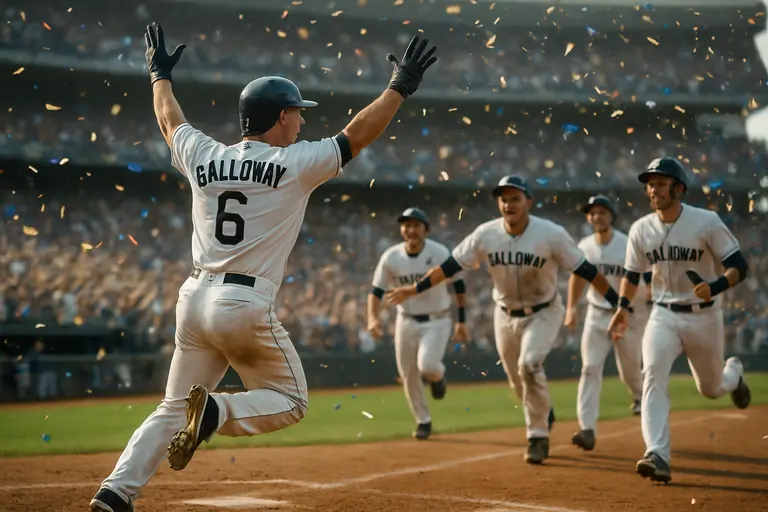
Rashawn Galloway’s most memorable tournament moment came on May 22, 2026, when he delivered a game-winning single against Louisiana to send Texas State to the Sun Belt Conference Championship semifinals. A walk-off hit carries instant emotion, but its deeper value is how it confirms trust. Coaches trust the at-bat. Teammates trust the moment. The crowd sees the player meet the pressure in real time.
That hit also fit the pattern of his season. He had already produced consistent contact, record doubles and conference recognition. The walk-off did not appear out of nowhere. It was the late-game version of the same skill set Texas State had leaned on across the schedule: stay through the baseball, put the ball in play with authority and force the opponent to execute under stress.
For the Bobcats, a semifinal berth in the conference tournament kept the postseason push alive and gave the fan base another snapshot of what this roster had become. Tournament runs are often remembered through single plays, but those plays usually come from players who have earned the chance before the moment arrives.
The Astros Selection Added A Professional Marker
Rashawn Galloway was selected by the Houston Astros in the 16th round of the MLB Draft on July 12, 2026, according to Texas State’s official announcement. That selection gave his season a professional endpoint and gave the Bobcats another development win to point toward in recruiting conversations.
Draft selections matter inside college programs because they connect day-to-day work to visible opportunity. For Texas State, Galloway’s selection was not just an individual honor. It was evidence that a player can come through San Marcos, improve across multiple seasons, help the team win high-stakes games and leave with a professional path.
What Galloway’s Run Means For San Marcos Baseball
Rashawn Galloway’s 2026 season should be remembered in San Marcos as more than a stat line. The .318 average, 84 hits, 27 doubles, 12 home runs and 48 RBIs give the profile its shape, but the context gives it weight. He produced during a year that ended with Texas State making its seventh NCAA postseason appearance. He delivered against Louisiana in both March and May. He gave the lineup stability, gave the defense options and gave the program another MLB Draft name.
For a local fan base, that is the kind of player profile that sticks. College baseball seasons move quickly, especially once conference play and tournament brackets arrive, but development stories give a program continuity. Galloway’s path from Boerne standout to Texas State lineup force to Astros draft pick is a clean example of what the Bobcats can sell: regional roots, college growth and meaningful baseball in San Marcos.
The next Texas State team will have to replace his production in practical ways. That means finding doubles, run production and a dependable presence in the order. It also means identifying which returning players are ready to take on larger roles after seeing what a complete offensive season can look like. That is how one player’s growth can shape a depth chart even after he leaves it.
For Texas State baseball, the lesson from 2026 is clear enough: tournament teams need stars, but they also need players whose development raises the standard for everyone around them. Galloway became that player during the Bobcats’ run.