The Houston Texans sold out eight open training camp practices in less than two hours, a reflection of how much expectations have risen around a franchise coming off a 12-5 season and three consecutive playoff appearances under DeMeco Ryans. The most revealing part of those public workouts has had little to do with autograph lines, packed viewing areas or the excitement surrounding C.J. Stroud. Houston’s August practices have become an extended examination of whether another rebuilt offensive line can support a roster ready to contend deeper into January.
Houston entered camp with five significant variables across the front: second-year left tackle Aireontae Ersery, veteran left guard Wyatt Teller, first-round rookie Keylan Rutledge, returning right guard Ed Ingram and a right-tackle competition involving Braden Smith and Trent Brown. General manager Nick Caserio did not make cosmetic changes after 2025. Houston signed Teller and Smith, retained Brown and Ingram and traded up to select Rutledge No. 26 overall.
Two weeks of practices have started separating the stable pieces from the unresolved ones. Rutledge is emerging as the likely starting center. Smith and Brown are still splitting work on the right side. Houston’s defensive front has repeatedly reached Stroud during padded periods. Those developments make the offensive line the central football story behind every open practice.
The 2025 Numbers Explain Why Houston Rebuilt The Line Again
The Texans won 12 games last season, scored 23.8 points per game and defeated Pittsburgh 30-6 for the franchise’s first road playoff victory. Their season still ended one round later with a 28-16 loss at New England. Houston’s defense allowed only 17.4 points per game during the regular season, ranking among the NFL’s strongest units, which placed greater attention on an offense that never matched that standard consistently.
Pass protection improved substantially from 2024, when Stroud was sacked 52 times. Stroud was sacked 23 times across 14 regular-season games in 2025. The improvement did not produce a complete offensive-line solution. Houston’s running backs averaged 3.9 yards per carry and scored only nine rushing touchdowns, figures that ranked near the bottom of the league.
Woody Marks led Houston with 703 rushing yards but averaged 3.6 yards per attempt. The broader team rushing attack finished with 1,852 yards, yet the blocking did not create enough dependable early-down production to give Stroud consistently favorable situations.
That history is why the Texans’ 2026 offensive-line overhaul matters more than a normal preseason position battle. Houston is trying to protect its quarterback and create a running game strong enough to complement an elite defense.
The challenge is not finding five recognizable names. It is finding five players who can function together when the defensive front creates real pressure.
Keylan Rutledge Has Become The Most Important Camp Development
Houston traded up two spots in April to select Rutledge with the 26th overall pick. The Georgia Tech lineman arrived with 3,019 college snaps, 43 starts and back-to-back first-team All-ACC selections. Georgia Tech ranked third nationally in fewest sacks allowed per game in 2025 with Rutledge playing inside.
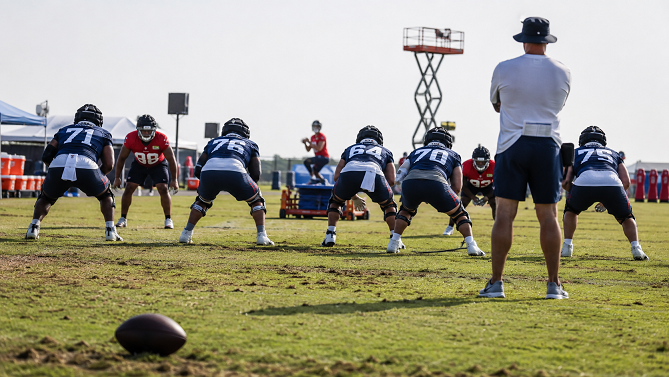
Houston drafted him as a guard who had enough experience and athletic ability to cross-train at center. By mid-August, center appears to be where he can help fastest.
Rutledge has moved ahead in the competition and received substantial first-team work. Houston Chronicle reporting from August 12 identified him as the frontrunner to start at center, a development that has reduced Jake Andrews’ repetitions with the first unit.
That shift could solve several problems at once.
Putting Rutledge at center allows Houston to keep Teller at left guard and Ingram at right guard, creating a veteran pairing around the rookie. It gives offensive-line coach Cole Popovich a physical interior blocker at the point where protection calls and run-game combinations begin.
Caserio’s draft-night comments made Houston’s priorities clear. The organization valued Rutledge for toughness and physicality and stated its intention to run the football more effectively in 2026. Rutledge said after the draft that protecting Stroud and making the running game easier were immediate goals. The Texans’ first-round evaluation of Rutledge was built around those traits.
Camp has shown that the rookie may be ready for far more than a developmental role.
Right Tackle Remains The Largest Unanswered Question
The interior is becoming clearer. Right tackle is not.
Houston signed Braden Smith on March 13 after his long run with Indianapolis. Trent Brown had already received a contract extension three days earlier. The plan gave Houston two experienced tackles and enough depth to avoid handing the position to one player before camp.
That competition is still active.
Smith and Brown were sharing first-team repetitions during Houston’s August 12 preparation for the Chargers. Neither had clearly separated enough for Ryans to name the job settled.
The delay is meaningful given what has happened during padded work.
Houston’s August 10 practice produced three sacks of Stroud in a relatively short sequence. Will Anderson Jr., Jadeveon Clowney and Sheldon Rankins each got home as the defense overwhelmed protection. The August 8 scrimmage-style practice had already featured several tackles for loss. Reporting from camp identified the outside protection as the main source of recent concern.
Houston owns one of the NFL’s most difficult practice environments for an offensive tackle. Anderson and Danielle Hunter can test the edge every morning. That makes losses in camp understandable. It makes repeated losses useful evidence.
Smith and Brown are not being asked to look dominant against ordinary competition. They need to show they can keep Houston’s offense functional against the type of edge rush the team expects to face in January.
Houston’s Defense Is Giving The Line The Right Test
One reason the open practices matter is the opponent standing across the ball.
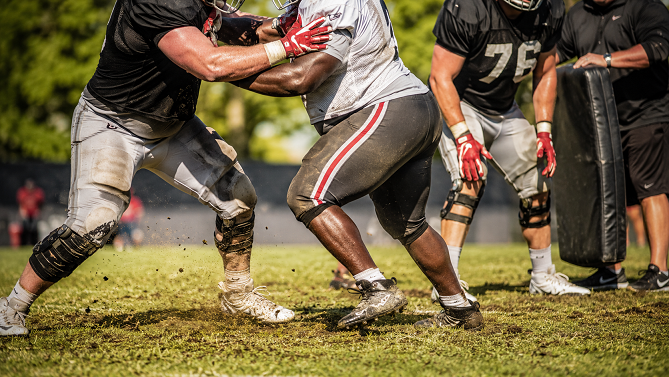
Anderson and Hunter form an elite edge pairing. Rankins provides interior disruption. Houston’s defensive group finished second in points allowed in 2025 and has continued creating pressure during camp. NFL.com identified the unit as the strongest part of the roster entering the summer.
For the offensive line, that creates a difficult but valuable daily test.
A clean practice against a weak rush could create false confidence. Houston has little chance of receiving that type of environment. Tackles must handle speed and length. Guards must anchor against interior pressure. Rutledge must make calls and then execute blocks against established NFL defenders.
The August 10 practice showed both sides of the equation. Stroud produced successful red-zone plays earlier in the session, including a 17-yard touchdown to Marlin Klein. Later, the defensive front took over, producing three sacks.
That contrast is useful.
The Texans do not need an offensive line that wins every practice rep against Anderson and Hunter. They need one that can recover from losses, communicate under pressure and prevent one bad snap from becoming an entire bad series.
Those habits will matter more than any unofficial practice score.
David Montgomery Changes What Houston Wants From The Front
Houston’s offensive-line evaluation is tied closely to another major offseason move.
The Texans acquired David Montgomery from Detroit on March 11, sending center-guard Juice Scruggs to the Lions as part of the roster restructuring. Montgomery joined Marks in a backfield designed to give Houston a more physical and efficient rushing identity.
That matters for Teller, Rutledge and Ingram.
Houston does not want the line evaluated only through sacks allowed. Caserio has openly discussed building a more physical running game, and the front office spent meaningful resources on players who fit that plan.
Montgomery offered an example of the expanded offensive possibilities during the August 12 dress-rehearsal practice. Stroud connected with him on an approximately 80-yard wheel-route touchdown, one of the longest plays of camp. The play was created through the passing game, but it demonstrated why Houston wants a backfield that can create more than straightforward rushing attempts.
A stronger line would give offensive coordinator Nick Caley more ways to use Montgomery and Marks. Houston could stay committed to the run on early downs, build play-action from it and make defensive fronts account for more than Stroud’s passing ability.
The running game finished 2025 without that level of consistency.
C.J. Stroud’s Evaluation Cannot Be Separated From Protection
Stroud remains one of the central figures of Houston’s season, yet assessing his camp accurately requires context around the players in front of him.
He completed 64.5% of his passes for 3,041 yards, 19 touchdowns and eight interceptions across 14 regular-season games in 2025. His season ended with four interceptions against New England in the divisional round.
NFL.com entered training camp describing the line and Stroud as connected issues. Protection problems had affected his comfort, timing and decision-making, even in situations where pressure did not arrive immediately.
That connection is still visible in camp.
When protection holds, Houston’s passing game has produced promising red-zone work and explosive plays. When the edges collapse quickly, Stroud has little opportunity to test the deeper structure of the offense.
The line cannot eliminate every pressure. No NFL group can. It must create enough stability that Stroud’s success or failure becomes more clearly attributable to quarterback play rather than constant pocket disruption.
That is why the open practices have functioned as offensive-line evaluations even when the crowd is watching Stroud throw touchdowns.
The Chargers Game Moves The Evaluation Into A New Stage
Houston’s first preseason game arrives Thursday, August 13, against the Los Angeles Chargers at Reliant Stadium. Kickoff is scheduled for 7 p.m. Central. The Texans then host Las Vegas on August 20 before traveling to Carolina for their August 28 preseason finale.
The official Texans preseason schedule gives the offensive line three different evaluation environments before Week 1 against Buffalo.
The Chargers game matters first.
Practice rules limit how completely defenders can finish pressure around a quarterback. Preseason snaps create a more natural pocket, clearer run-blocking results and fewer assumptions about whether a defender would have recorded a sack.
Houston can evaluate Rutledge’s snaps and communication against another defensive front. Smith and Brown can receive live evidence in the right-tackle competition. Ersery gets another stage in his development at left tackle. Teller and Ingram can start building the interior continuity that Houston expects to carry into September.
The results should be read through execution rather than the preseason score.
A five-man unit that communicates cleanly and creates running lanes can have a productive night without Houston scoring 30 points. A group that allows repeated immediate pressure will give the coaching staff another reason to keep experimenting.
The Raiders Joint Practice Could Decide The Final Configuration
Houston has one more open practice on August 18, and it may become the most useful one.
The Texans will work against the Las Vegas Raiders at the Houston Methodist Training Center before the teams meet two nights later in preseason. Houston will later travel to Charlotte for another joint practice with Carolina ahead of the August 28 finale.
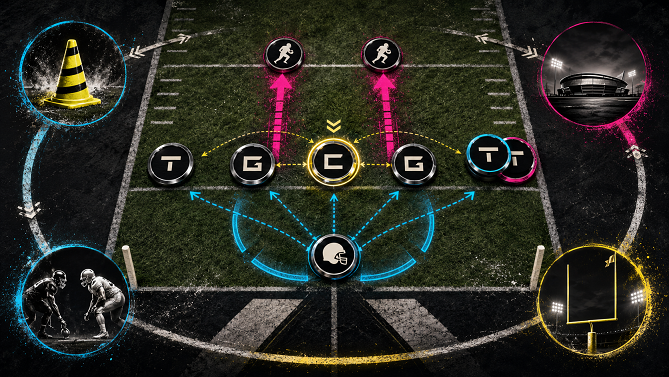
Joint practices remove the familiarity that develops inside training camp.
Houston’s linemen know Anderson’s preferred moves. They know Hunter’s alignments. They understand the cadence of their own offense and recognize the defensive calls they have seen repeatedly since July.
Las Vegas provides different techniques, different personnel and less predictable pressure.
For Rutledge, that session can test protection communication against unfamiliar fronts. For Smith and Brown, it can help separate the right-tackle competition. For the entire unit, it offers a better approximation of the uncertainty that begins September 13 against Buffalo.
The August 18 practice was advertised as a fan event. From Houston’s football perspective, it may be the final major public exam for the most important position group on offense.
Why Houston’s Season May Be Decided Up Front
The Texans already know what their defense can do.
Houston allowed 295 points last season, won 12 games and developed a unit capable of keeping the team competitive against playoff opponents. Anderson, Hunter, Derek Stingley Jr., Kamari Lassiter, Jalen Pitre and Calen Bullock give Ryans high-level talent throughout the defense.
The greater uncertainty sits in front of Stroud.
Teller was signed to strengthen the interior. Smith was added to compete at tackle. Ingram was retained. Rutledge cost Houston a first-round pick and a trade up the board. Montgomery was acquired partly to give the running game a different identity. Those moves form one connected strategy rather than separate transactions.
The open practices have provided an early reading.
Rutledge is moving toward the starting center job. The interior has a clearer structure. Right tackle remains unresolved. Houston’s pass rush has exposed enough protection problems to prevent complacency. The offense has still produced explosive and red-zone plays when the pocket holds.
That is exactly why the offensive line deserves more attention than any camp highlight.
Houston does not need another August of convincing itself the unit looks improved on paper. It needs five linemen who can operate together against Buffalo, Cincinnati and Indianapolis in September and still hold up when the schedule reaches playoff-caliber defensive fronts.
The eight open practices gave fans access to one of the NFL’s most anticipated Texas teams. For Ryans and Caserio, they have served another purpose.
They have been a prolonged test of whether Houston finally has the offensive line required for the championship expectations surrounding the rest of the roster.