Texas State roster depth is no longer just a spring-practice talking point in San Marcos. As the Bobcats prepare for their first football season tied to the Pac-12, every position group is being viewed through a sharper lens: who can handle a longer, more visible conference grind, who can stabilize the week-to-week rotation, and who gives head coach G.J. Kinne’s staff answers when injuries, travel and matchup demands arrive. The names at the top matter, but the Bobcats’ local story is also about how many trusted contributors can keep the program steady once the season starts.
Why Texas State roster depth Matters In The Pac-12 Move
Texas State roster depth Starts With Experienced Names
The first read on this roster is that Texas State has recognizable upperclassmen across key spots. CBS Sports lists Brad Jackson as a redshirt sophomore quarterback at 6-foot, 197 pounds, while senior wide receivers Chris Dawn Jr. and Beau Sparks are listed at 5-foot-9, 175 pounds and 5-foot-11, 181 pounds, respectively, on the CBS Sports roster. Those details do not settle a full depth chart, but they do show that the Bobcats are not entering their new league discussion with anonymous skill-position pieces.
That matters for a community that has watched Texas State build momentum through player development and roster competition. A Pac-12 schedule brings different bodies, different travel rhythms and a different level of weekly scrutiny. The strongest teams handle that by getting production beyond the first wave. For Texas State, the question is not simply whether the Bobcats have headline players. It is whether the second and third options can keep drives alive, protect field position and prevent one absence from reshaping a Saturday.
Preseason Honors Are Useful, Not A Depth Chart
The Bobcats received one of their clearest preseason markers when Texas State announced that 15 players were named to Athlon Sports’ preseason All-Pac-12 teams, with Jackson, Dawn, Sparks and return specialist Jaylen Jenkins earning first-team recognition in the Texas State Athletics release. That is meaningful because it shows respect for individual talent before the first league snap. It should not be confused with proof of finished roster depth.
Preseason teams reward known production, projection and reputation. Depth is proven when a receiver rotation holds up against physical coverage, when a backup lineman can survive a critical series, or when a special teams unit flips field position late in a close game. Texas State roster depth will be measured less by July lists and more by how the Bobcats respond when Pac-12 opponents force the staff to use the full bench.
Offensive Skill Spots Give San Marcos A Base
Quarterback And Receiver Chemistry Carries Weight
The offensive starting point is promising because the Bobcats have preseason recognition attached to the passing game. Jackson being named a first-team preseason All-Pac-12 quarterback by Athlon gives Texas State a visible offensive face entering the year. Dawn and Sparks receiving first-team wide receiver honors gives the passing game a pair of perimeter names that local fans can rally around.
That combination is important in San Marcos because receiver depth often shapes how a play-caller handles long drives. If defenses tilt coverage toward one target, the offense needs another route runner to punish that choice. If tempo is part of the plan, the staff needs enough wideouts to keep legs fresh without losing timing. The top-end talent is encouraging, but the bigger evaluation is whether the Bobcats can keep the same rhythm when rotations expand.
For fans tracking how this roster was assembled, the wider recruiting and transfer picture also matters. The program’s 2026 roster conversation connects naturally to our recent look at Texas State recruiting, where quarterback depth and roster competition sit at the center of the Bobcats’ move into a bigger conference setting.
Backfield And Return Value Add Needed Flexibility
The running back room brings a different kind of depth question. CBS lists Torrance Burgess Jr. as a redshirt senior running back at 5-foot-8, 176 pounds and Jaylen Jenkins as a redshirt senior running back at 5-foot-8, 173 pounds. Jenkins also has first-team preseason recognition from Athlon as a kickoff return specialist, which gives his role added importance beyond standard offensive snaps.
That dual value can change game management. A player who can contribute in the backfield and in the return game gives the staff more paths to influence field position. It also raises workload questions that need careful handling during a long season. If Jenkins is central to special teams, Texas State has to balance offensive touches with return responsibilities. That is where Texas State roster depth becomes practical. The Bobcats need enough trusted backs to maintain rushing production without draining one of their most valuable field-position players.
- Jackson gives the offense a recognized quarterback name entering the Pac-12 conversation.
- Dawn and Sparks provide preseason first-team receiver credentials on the outside.
- Jenkins adds value as both a running back and return specialist.
- Burgess gives the backfield another experienced upperclassman option.
The Line Of Scrimmage Will Shape The Rotation
Offensive Front Depth Is The Pressure Point
Skill talent draws the attention, but the Pac-12 move will put a heavy burden on the offensive front. The research notes identify redshirt junior offensive tackle Bamidele Badusi at 6-foot-6, 328 pounds, giving the Bobcats a large tackle body in the roster evaluation. Size alone does not decide protection, but it matters when the schedule begins to bring longer, more physical defensive fronts into the weekly preparation cycle.
The offensive line is where depth can be hardest for a growing program to prove. A receiver rotation can hide a young player in certain packages. A running back can be used situationally. An offensive lineman has to win repeated snaps in full view, often against the opponent’s best athletes. If Texas State wants its quarterback and receiver strengths to travel well, the line must give the offense enough clean downs to stay on schedule.
Defensive Front Answers Must Travel
The defensive side carries similar pressure. The research notes point to DonTerry Russell on the defensive line and Terrence Cooks II at linebacker as upperclassmen tied to preseason recognition from another college football publication. Because that specific source is not among the permitted links for this piece, the safest read is restrained: Texas State appears to have veteran names in the front seven, but the weekly defensive rotation still has to be proven on the field.
That is the honest place to land. The Bobcats can feel encouraged by experienced defenders, but depth is about more than the first huddle. Pac-12 offenses will test substitutions, communication and tackling angles. Linebackers must handle run fits, coverage drops and tempo checks. Defensive linemen must hold their gap discipline without wearing down before the fourth quarter. If the Bobcats can rotate up front without losing force, the defense has a better chance to keep games within the style Kinne’s staff wants.
What The Roster Means For San Marcos Game Days
Local Confidence Comes From Trustworthy Roles
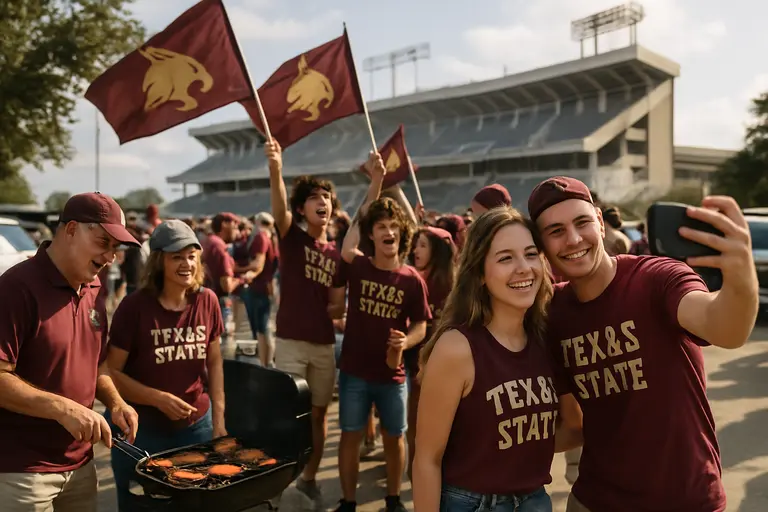
For the San Marcos sports community, roster talk is not just a list of heights, weights and class years. It becomes part of how families, students and alumni read the season. The more defined the roles become, the more personal the connection feels on game day. A kickoff returner who changes field position, a receiver who wins a third down, or a backup lineman who steps in cleanly can become part of the week’s conversation from campus to local restaurants.
That is why Texas State roster depth carries community meaning. The Bobcats are entering a higher-profile conference setting, and the local fan base wants to see a team that looks prepared for that stage. Not perfect. Prepared. There is a difference. Prepared teams know who their swing tackles are. Prepared teams know which receiver can play multiple spots. Prepared teams know which defensive back can enter after a long drive and still communicate the coverage call.
Development Facilities And Daily Competition Matter
Depth is built long before kickoff. It shows up in winter strength work, summer conditioning, position meetings and practice reps that never reach a broadcast. That is why the program’s investment in player development is part of the roster story. Our coverage of how Texas State facilities build depth fits this discussion because better training, meeting and recovery spaces can help turn roster numbers into playable depth.
The Bobcats do not need every reserve to become a star. They need enough players to be ready for defined jobs. A fourth receiver may need to block on the perimeter. A reserve linebacker may be asked to cover kicks before he takes major defensive snaps. A backup running back may need to protect the quarterback on third down. Those quieter assignments often decide whether a roster is truly deep or merely crowded.
Why Texas State roster depth Sets The First Pac-12 Tone
The First Season Will Reward Reliable Layers
The cleanest evaluation of Texas State’s roster is balanced. The Bobcats have preseason recognition at premium offensive spots, a return specialist with first-team notice, experienced names in the backfield, and enough listed upperclassmen to suggest a roster that is not starting from scratch. That is a solid foundation for a program stepping into a new league identity.
The caution is just as clear. Public rosters and preseason teams cannot answer every depth question. They do not show whether a second-team corner can hold up against a bigger receiver. They do not prove whether the offensive line can absorb a midgame injury. They do not guarantee that special teams can remain sharp while key players carry multiple roles.
For Texas State, that uncertainty is part of the season’s drama in the best sports sense. San Marcos has a team with recognizable talent and a fan base ready to see how that talent stretches across four quarters and a full schedule. If the Bobcats turn their upperclassmen and preseason honorees into a steady rotation, Texas State roster depth could become one of the strongest local storylines of the program’s first Pac-12 season.