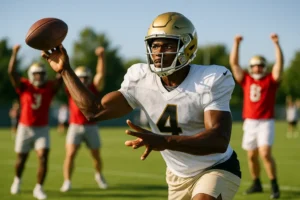
The Dallas Cowboys entered 2026 training camp with enough offseason change that helmets and shorts could reveal only so much. Once the pads came on August 3 in Oxnard, the questions became more useful: Can Christian Parker’s rebuilt defense handle physical football? Are Caleb Downs, Malachi Lawrence and Jaishawn Barham ready for NFL contact? Has Tyler Guyton stabilized left tackle? Can Dallas create a deeper roster instead of leaning almost entirely on established starters?
The first week of padded work has produced encouraging answers without settling the roster. The strongest evidence came August 11, when Dallas left Oxnard for a joint practice against the Los Angeles Rams in Woodland Hills. The Cowboys’ defense pressured Matthew Stafford, created turnovers and showed much more resistance than the unit that allowed an NFL-worst 511 points in 2025.
That session did not prove Dallas has repaired every weakness. Rams edge rusher Myles Garrett did not participate, limiting one of the best possible tests for the Cowboys’ offensive tackles. Preseason games against Seattle, Arizona and New Orleans will create another evaluation stage.
The useful development is that Dallas’ rebuild is beginning to look less theoretical.
The Pads Made Dallas’ Defensive Rebuild Easier To Judge
Christian Parker inherited an extraordinary problem.
Dallas went 7-9-1 in 2025 and surrendered 511 points, an average of 30.1 per game and the worst figure in the NFL. The Cowboys responded by changing the defensive staff and substantially changing the personnel around it.
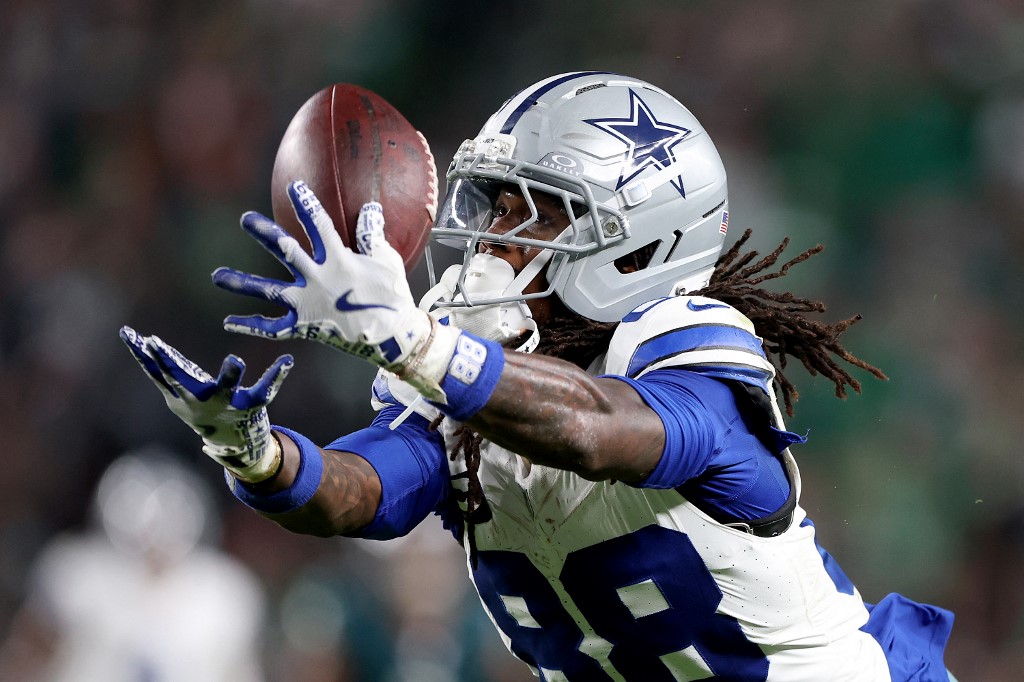
The offseason included a trade for edge rusher Rashan Gary, the additions of safeties Jalen Thompson and P.J. Locke and cornerback Cobie Durant, plus a draft class led by Downs and Lawrence in the first round and Barham in the third. Quinnen Williams and Kenny Clark remained at the center of the defensive line, giving Parker experienced interior players around the new pieces. The Cowboys’ defensive roster rebuild made clear that Dallas was changing both personnel and structure rather than expecting a new coordinator to repair the same group.
Non-contact practices helped Parker install formations, coverage responsibilities and communication rules. Padded work provided a better measure of whether those ideas survived physical pressure.
That distinction matters for Dallas. The 2025 defense did not fail only through complicated tactical mistakes. It struggled to stop drives, control explosive plays and consistently win physical situations.
The early padded sessions have given Parker opportunities to examine run fits, edge-setting, block destruction and tackling mechanics. The August 11 Rams practice added another layer by forcing Dallas to execute against unfamiliar personnel rather than teammates whose tendencies had become predictable.
The results were encouraging enough to treat the defensive progress seriously, even if September remains the real test.
Caleb Downs Is Showing Why Dallas Plans To Move Him Around
Downs entered camp as the 11th overall selection in the 2026 NFL Draft and immediately received responsibilities beyond a conventional rookie safety role.
Dallas used him at safety and nickel during the first practice of camp, placing him against Dak Prescott and the first-team offense. That deployment fits Parker’s preference for a multiple defense in which the same personnel can create different looks before the snap.
The pads matter for Downs because versatility at safety is about more than coverage.
A player positioned near the line of scrimmage has to handle blocking angles, fit the run and work through traffic. Nickel responsibilities add another set of physical problems against receivers, tight ends and motion. Deep safety asks for range and communication without removing the need to tackle in space.
Early camp assessments have continued to identify Downs as one of the rookies whose reputation has held up once contact increased. Lawrence has generated similar attention on the edge, and Barham has strengthened his case for meaningful linebacker repetitions.
Dallas does not need Downs to become an All-Pro during his first training camp. It needs him to be versatile enough that Parker can change calls without substituting.
That can make the entire secondary harder to identify before the snap. Jalen Thompson can shift responsibilities. Durant can work in the slot. DaRon Bland and Shavon Revel can handle outside assignments. Downs can become the piece that connects those combinations.
His training camp is less about winning one starting position than showing how many positions Dallas can trust him to play.
The Linebacker Room Looks Deeper Than It Did In The Spring
Linebacker was one of the Cowboys’ clearest concerns entering the draft.
DeMarvion Overshown was positioned to take a larger communication role, but Dallas needed more playable bodies around him. Barham arrived with experience both inside and near the edge, giving Parker another defender whose role could change with the front. Dallas’ own pre-camp assessment described Barham as a linebacker with the physical and athletic tools to cover substantial ground. Jaishawn Barham’s role has grown more interesting as contact has increased.
Justin Barron has created an even more unexpected storyline.
Barron entered 2026 having appeared in only two regular-season games for Dallas, both late in 2025. During the August 11 Rams practice, reports credited him with three interceptions — one against Stafford and two against Stetson Bennett. Dallas’ pressure also disrupted the Rams’ passing periods repeatedly.
Three practice interceptions should not be treated like three regular-season takeaways. Their value lies in what they reveal about roster competition.
A player who entered camp near the edge of the defensive depth chart is forcing the coaching staff to find more evaluation reps. That is how a rebuilt roster becomes deeper: players outside the projected starting lineup make themselves difficult to remove.
Overshown, Barham, Barron and other linebackers still have to prove they can handle the run and communicate Parker’s calls over a full preseason. The room now appears more competitive than it did before the draft.
Shavon Revel Could Be One Of The Most Important Internal Improvements
Not every meaningful addition came through free agency or the draft.
Shavon Revel spent much of his rookie year recovering from the major knee injury he suffered during his final college season. The 2026 offseason is his first healthy NFL offseason, and Dallas identified that availability as important before camp began.
The first practice included a brief scare when Revel knocked knees with another player, but he said afterward that he was fine. Since then, his work has increasingly placed him among the secondary’s most interesting players.
Against the Rams, Revel reportedly broke up multiple passes and forced a fumble during his work against Puka Nacua. That came in the same session where Dallas’ pass rush and linebackers repeatedly disrupted Los Angeles’ offense.
Revel’s emergence matters for roster construction.
The Cowboys added Durant and Thompson partly because the secondary needed experienced help. A healthy Revel gives them another outside corner with size and developmental upside. Bland no longer has to carry every major matchup, and Parker gains more freedom to determine where Durant and Downs are most useful.
The Cowboys’ secondary rebuild was designed around adding takeaways and versatility after a poor defensive season. Revel becoming a dependable part of that rotation would turn an offseason weakness into a potentially deep position group.
Tyler Guyton’s Progress Matters More Once The Rush Gets Real
Dallas’ offensive line entered camp with a different type of question.
Tyler Smith remains one of the NFL’s strongest guards, yet the Cowboys have continued preparing him for emergency tackle work. Brian Schottenheimer said before the first practice that Smith would begin at left guard and receive some tackle repetitions so Dallas would have contingency options.
That plan puts more pressure on Tyler Guyton.
The 2024 first-round pick has had to prove that left tackle can remain his position without forcing Dallas to move Smith away from the interior. Camp reports through the first padded practices have increasingly treated Guyton as the clear first-team option rather than a player trapped in a wide-open competition.
The August 11 Rams practice should have been one of his largest tests. Los Angeles acquired Myles Garrett during the offseason, creating the possibility that Dallas’ tackles would work against one of the league’s elite pass rushers.
Garrett sat out with a knee issue, reducing the value of that specific matchup.
The absence does not erase what the Cowboys have learned from Guyton’s padded work. It means the evaluation remains incomplete.
Seattle’s preseason game on August 15 and the August 18 joint practice against New Orleans will create further opportunities. Dallas needs to know whether Guyton can handle speed, counter moves and sustained physical pressure without requiring regular protection help.
If he can, Smith stays at guard and the offensive line retains its preferred structure.
George Pickens Gives The Offense A Different Physical Problem
The pads have reinforced another point that was visible before camp: George Pickens changes the way Dallas can attack defensive backs.
Pickens reported to camp under the franchise tag after making clear during minicamp that he did not intend to hold out. He entered Oxnard fully available, giving Prescott a proven outside receiver opposite CeeDee Lamb.
His combination of size, ball skills and physical play has consistently generated positive camp attention. The Rams session produced another strong day, with Pickens continuing to make plays against unfamiliar defensive backs.
That matters when projecting Dallas’ roster beyond simple receiving statistics.
Pickens can force defenses to protect the boundary, giving Lamb more freedom to move through the formation. His contested-catch ability creates an option when protection breaks down or Prescott faces tight man coverage. His presence can open space for tight ends and running backs underneath.
Dallas’ offense was already productive in 2025. The larger problem was asking that offense to compensate for a defense allowing 30.1 points per game.
The early padded work suggests the Cowboys may have improved both sides of that equation: more physical receiving options on offense and a defense creating more disruption.
The Rams Practice Offered The Best Test So Far
Practice against teammates has limits.
Prescott knows Parker’s defensive concepts. Dallas defenders know the offense’s motions, cadence and favorite combinations. Repeated training-camp meetings eventually create familiarity that can make both sides appear better prepared than they would against an opponent.
The August 11 session in Woodland Hills removed part of that familiarity.
The NFL officially scheduled Dallas and Los Angeles for a joint practice before the preseason, giving the Cowboys a controlled environment against a Rams roster built to contend in the NFC. The Cowboys’ training camp calendar now moves from that Rams test toward the preseason opener in Seattle on August 15 and another joint session with New Orleans on August 18.
Dallas’ defense produced the most encouraging evidence in Los Angeles. Barron’s interceptions, Revel’s coverage work and pressure around Stafford suggested Parker’s group can create problems against an offense it did not spend two weeks practicing against.
The offense had positive stretches as well, though the Rams created difficulties in red-zone and situational work. That balance is useful for Schottenheimer.
Training camp should expose problems before the regular season does.
What Dallas Still Needs To Learn Before Week 1
The first padded practices have changed several Cowboys questions without eliminating them.
Downs looks capable of handling multiple responsibilities. Barham is pushing for early linebacker work. Barron has turned himself into a serious roster evaluation. Revel looks healthier and more disruptive. Guyton appears better positioned to remain at left tackle. Pickens has given the offense another physical receiving threat.
The largest development is still collective.
Parker’s defense looks faster and more competitive than the unit Dallas fielded in 2025, at least through the first meaningful contact period of camp. That is a far more valuable development than one spectacular catch or one practice interception.
The Cowboys now need repetition.
The 2026 preseason schedule sends Dallas to Seattle on August 15 and Arizona on August 22 before the August 28 home finale against New Orleans. The Saints will already have given the Cowboys another controlled test during their August 18 joint practice in Oxnard.
Those dates will help separate real roster progress from strong practice stretches.
Dallas rebuilt its defense aggressively, added high draft picks and created competition across several positions. The first padded sessions have supplied evidence that some of those moves are translating onto the field.
The next stage is proving they hold up when tackling is live, quarterbacks cannot be protected by practice rules and every snap affects whether a player reaches the 53-man roster.
That is what makes the early padded practices valuable. They have not finished the Cowboys’ roster evaluation.
They have finally made it real.