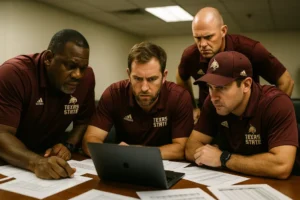
Texas State recruiting moved quickly in January, with the Bobcats adding 19 student-athletes through the transfer portal following the second signing window, according to the school’s official roster announcement. The group is not built around one position or one short-term need. It reaches across the offensive line, defensive front, linebacker room, secondary, special teams, quarterback depth and flexible skill spots. For a San Marcos program working to raise its week-to-week standard, the size and spread of the class give spring practice a different feel: more bodies, more competition, and more evaluation before the season arrives.
Texas State Recruiting Adds January Answers
The January transfer group gives Texas State a clearer picture of where the staff wanted immediate options. Transfer work is not the same as signing high school prospects and waiting years for development. These players arrive with college backgrounds, and Texas State announced them as January enrollees, which places them in position to take part in spring practices and the upcoming season.
That timing matters for the Bobcats. A January enrollee has a chance to learn terminology, build conditioning habits with the team, and compete before preseason camp. The coaching staff can also use spring periods to sort early pecking orders without waiting until summer arrivals report. None of that guarantees roles, but it gives both players and staff a longer runway.
Texas State Recruiting On The Lines
The most direct reading of the class starts up front. Texas State added offensive linemen William Boone from North Carolina and Prairie View A&M, Jaylen Early from Missouri, and Rasheed Jackson from TCU and UIW. The school’s announcement lists all three among the January additions, giving the Bobcats new competition in a position group where depth can shape an entire offense.
For Texas State recruiting, the line group is one of the clearest signals from this window. Offensive line play affects quarterback comfort, run-game consistency, red-zone execution and the ability to handle injuries across a long season. Adding three linemen does not name starters, but it does widen the room and gives spring practice more live evaluation points.
Quarterback, Receiver And Athlete Flexibility
The Bobcats also added quarterback Shaker Reisig from Boston College. Quarterback additions are always watched closely by a local fan base because they influence practice rhythm as much as game plans. Even when a transfer is brought in to build depth, the room benefits from added competition and another player taking spring reps.
Texas State also added Zechariah Sample from Arizona State, listed in the research as a versatile athlete and wide receiver option, along with Davian Jackson from Mississippi State as another flexible athlete. That part of the class is harder to define from the outside because role depends on where each player lines up during practice. What can be said with confidence is that the Bobcats added players with multi-position potential rather than limiting the January group to one narrow skill area.
The Position Groups Texas State Addressed
The defensive additions are the largest share of the January group. Texas State brought in six defensive linemen, two linebackers and three defensive backs. That is 11 defensive players before counting any athletes who may work on that side of the ball. The number alone shows the Bobcats wanted more options at multiple levels of the defense.
Defensive Front And Linebacker Help
The defensive line additions are Phillip Bradford from McNeese, Mekhi Buchanan from Virginia, Kaleb James from Arkansas, Chancellor Owens from Arizona and Northwestern State, Jason Patterson from Texas Southern and Duquesne, and Tae Woody from ULM, UAB and Florida State. That group brings a wide range of previous college stops into the same room.
Linebackers Javante Mackey and Jordan Sample both arrived from Arkansas State. With those two, Texas State added to the middle level of the defense after already bringing in a large defensive front group. The combination gives the staff more room to test fits, run groupings and special teams value during spring work.
Secondary And Specialists Join The Room
The secondary additions are Michael Patterson III from Stephen F. Austin, Dexter Ricks Jr. from Liberty and John Smith from Colorado State. Defensive backs often have to earn trust through coverage discipline, communication and tackling, so January arrival gives that group valuable time to adjust before the pace picks up later in the year.
Special teams were addressed as well. Texas State added kicker Dylan Cunanan from Toledo and punter Tom Flintoff from Melbourne, Australia. Those positions can be overlooked in transfer coverage, but they carry real game-day weight. Field position, kickoff decisions and late-game kicking situations are part of roster building, not side notes.
| Area | January Additions |
|---|---|
| Offensive Line | William Boone, Jaylen Early, Rasheed Jackson |
| Defensive Line | Phillip Bradford, Mekhi Buchanan, Kaleb James, Chancellor Owens, Jason Patterson, Tae Woody |
| Linebacker | Javante Mackey, Jordan Sample |
| Defensive Back | Michael Patterson III, Dexter Ricks Jr., John Smith |
| Special Teams | Dylan Cunanan, Tom Flintoff |
| Quarterback And Athletes | Shaker Reisig, Davian Jackson, Zechariah Sample |
Readers tracking the broader roster build can compare this January group with our earlier portal depth story, which focused on how transfer additions can create immediate competition across position rooms.
How January Enrollment Shapes Spring Competition
Texas State’s announcement that all 19 transfer additions are January enrollees is one of the most useful facts for evaluating the group. It means this is not only a signing list. It is a spring-practice list. The Bobcats can start teaching, testing and sorting roles before the normal summer roster squeeze.
Why The Calendar Matters
Spring football gives players a setting where coaches can slow installation, correct habits and test position fits. For transfers, that is especially valuable. They are learning new calls, new teammates and new practice expectations while trying to prove they can help quickly. A player who arrives in January does not have to make every adjustment during August camp.
The January group also shows how Texas State recruiting is using the portal to create depth rather than relying on one headline position. The Bobcats added a quarterback, linemen on both sides, defensive backs, linebackers, specialists and flexible athletes. That spread gives spring practices more competitive layers, from trench reps to return-game and kicking-period evaluations.
Local Ties Still Carry Weight
The class also includes in-state connections that matter to the San Marcos audience. Jaylen Early is from Duncanville, Texas, and Jordan Sample is from Missouri City, Texas. Those ties do not decide playing time, but they do keep part of the roster conversation connected to Texas high school football communities that many Bobcat fans know well.
Local recruiting identity is not only about signing prospects directly from nearby schools. It is also about bringing Texas players back into a college environment where families can follow them more easily and fans already understand the football culture they came from. For a program based between Austin and San Antonio, that connection matters on game days, in spring interest and in how supporters talk about the roster.
For more context on how the 2026 group fits the wider roster picture, our 2026 class outlook tracks the continuing balance between portal additions, depth needs and player development.
Why Texas State Recruiting Matters In San Marcos
This January transfer class gives the Bobcats more than a list of new names. It gives the local fan base a reason to watch spring practice reports with sharper attention. Which offensive linemen push into the rotation? Which defensive linemen provide the quickest fit? How does the quarterback room handle added competition? Do the specialists settle the kicking and punting picture early?
Roster Depth Meets Community Interest
The community angle matters because Texas State football is not followed in a vacuum. San Marcos businesses, alumni gatherings, student attendance and family travel all respond to the belief that the roster is being built with purpose. A large January transfer group can create that conversation before the first kickoff window is announced.
There is still uncertainty, and that should be acknowledged. The official announcement identifies the transfers and their previous schools, but it does not assign roles, depth-chart spots or production targets. Those answers have to come through practice and games. A January addition is an opportunity, not a promise.
For Texas State recruiting, that is the fair way to judge this group right now. The Bobcats addressed multiple roster areas, brought in all 19 transfers early enough for spring work, and added several players with Texas ties or multi-position value. The next step belongs on the practice field, where names from an announcement start becoming real competition in San Marcos.